- 1091 views
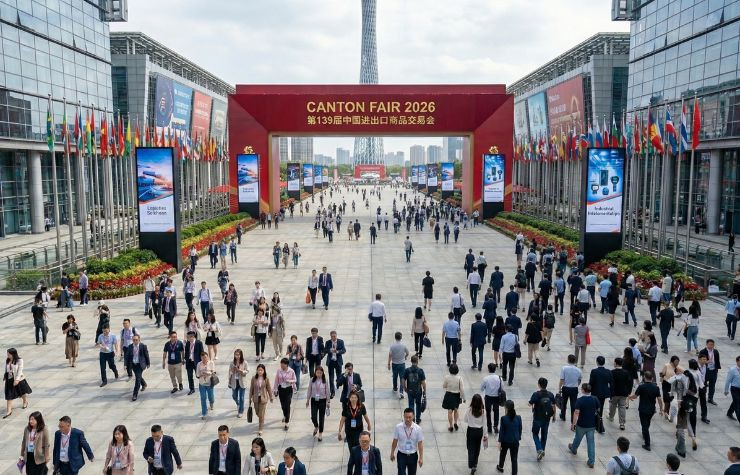
Importing from China Successfully: How to Negotiate, Secure, and Transport Cargo from the Canton Fair
In international trade, logistical planning and supplier validation are not a luxury—they are the guarantee of a safe and profitable operation.
Attending the Canton Fair is one of the best strategies to scale a business, but without the proper technical knowledge, financial risks multiply. Below, we break down the critical steps to protect your investment.
1. Which phase of the Canton Fair should I attend, and what are the mandatory legal requirements for entry?
The fair is divided into three phases to segment industries. It is critical to identify yours to avoid losing operational time:
- Phase 1: Electronics, household appliances, machinery, vehicles and spare parts, tools, and building materials. April 15 - 19.
- Phase 2: Consumer goods, gifts, home decor, toys, and toiletries. April 23 – 27.
- Phase 3: Textiles, footwear, office supplies, bags, recreational products, medicines, and food. May 01 – 05.
Specific actions for your trip:
- Business Visa (M): You must process this in advance by presenting the official invitation from the fair.
- Registration (Buyer Badge): Register on the BEST (Buyer E-Service Tool) platform. The first badge is free if requested online; obtaining it on-site costs approximately 150 RMB and requires your original passport and a photograph.
2. How do I verify if an exhibitor is a manufacturer or a middleman, and how do I negotiate the MOQ?
Differentiating a Trading Company from a real factory (Manufacturer) directly impacts your costs and customization capabilities (OEM).
Technical Validation: Request the Chinese Business License and verify the "Scope of Business" (经营范围). If it says "Production" or "Manufacturing," it is a factory; if it only mentions "Sales" or "Export," it is a middleman. Ask for social audit reports (BSCI, Sedex) or technical audits (ISO 9001).
Negotiating MOQ (Minimum Order Quantity): If this is your first import, do not accept the standard MOQ immediately. Propose a "Trial Order" by paying a small surcharge per unit, justifying it as a market validation phase before a massive purchase.
3. What security protocols and fraud prevention measures should I implement before closing a deal?
The greatest risk of fraud does not occur at the fair, but during post-event execution. Never proceed without these three filters:
- Bank Account Verification: Payments must go to a corporate account that exactly matches the name on the business license. Discard suppliers who request payments to personal accounts or offshore tax havens.
- Pre-Shipment Inspection (PSI): Hire a third-party inspection company to verify the goods at the supplier's warehouse before the container is sealed. Audit quantity, technical quality, packaging, and functionality.
- Sales Contract: It must include detailed technical specifications, defect tolerances, delay penalties, and a clause stating that the final payment is subject to the quality inspection results.
4. Which Incoterms and customs documents are critical to avoid surcharges and delays?
Poorly planned logistics can double the product's cost.
Recommended Incoterms: For greater control, use FOB (Free On Board). You choose the freight forwarder (Dietrich Logistics) and control the international freight. Avoid CIF if you lack experience, as suppliers often inflate "arrival charges" at the destination port.
Mandatory Documentation:
- Bill of Lading (B/L): The legal title of ownership for the cargo.
- Commercial Invoice and Packing List: These must be accurate regarding weights and measurements.
- Certificate of Origin: Vital for applying trade agreement benefits and reducing tariffs.
- Technical Data Sheets: Necessary for your customs broker to perform the correct tariff classification.
5. How to structure the international payment schedule to minimize financial risk?
The gold standard in trade with China is the 30/70 protocol:
- Initial Payment (30%): Transferred as a deposit to start production. This "locks in" the price and the raw materials.
- Production and Alert: The supplier notifies you of the order completion.
- Inspection and Final Payment (70%): Do not transfer the remaining balance until you receive a passing pre-shipment inspection report and a copy of the Draft Bill of Lading.
Secure Method: Use telegraphic transfers (T/T) or a Letter of Credit (L/C) if the amount exceeds $50,000 USD for enhanced banking security.